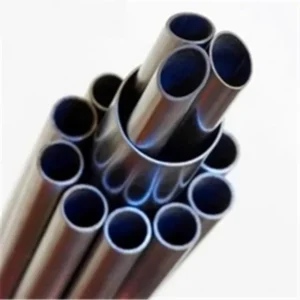
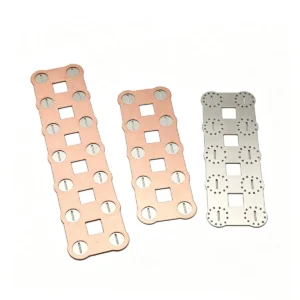
The customer is a leading German manufacturer focused on large-scale cylindrical battery module (21700) production. Previously used pure-nickel busbars produced excessive pack resistance and cell temperature rise during 3C discharge. Inconsistent pad dimensions from different suppliers also caused incomplete laser welds. The customer sought lower internal resistance and more consistent welding without changing the production line.
Case Overview
Jiangsu DZX supplied a German cylindrical battery pack (21700) manufacturer with a customized copper-nickel composite busbar solution. A metallurgically bonded copper-core/nickel-surface structure replaced pure-nickel busbars, significantly improving pack connection resistance and temperature rise during 3C discharge. Pads were stamped for the cell specifications to ±0.05mm tolerance, reducing laser-welding defects to nearly zero. Samples were delivered in 2 weeks and production orders in 3-5 weeks, helping improve performance and yield without changing the line.
| Client Profile | A German EV battery pack (21700) manufacturer |
|---|---|
| Application | Cylindrical battery-module busbars and cell interconnects |
| Materials Supplied | Copper-nickel composite sheet (copper core + nickel surface, metallurgically bonded) |
| Supply Forms | Custom stamped busbars for 21700 / 18650 / 4680 cells |
| Key Requirements | Reduced pack connection resistance and 3C discharge temperature rise; consistent pad dimensions for laser welding |
| Delivery Arrangement | Samples in approximately 2 weeks; production delivery in approximately 3-5 weeks, with dimensional inspection reports |
| Project Region | Germany |
Our Solution
To meet both conductivity and weld-quality requirements, we supplied customized busbars made from copper-nickel composite sheet:
- Copper-core/nickel-surface composite: The copper core (≥99.9%) provides conductivity ≥85%IACS; the nickel surface (≥99.5%) provides weldability and corrosion resistance, combining performance with processing compatibility.
- Custom pad stamping: Pad diameter and spacing tailored to 21700 cells, with critical dimensional tolerances of ±0.05mm.
- Adhesive-free metallurgical bonding: A roll-bonded structure prevents interfacial resistance growth in long-term use; each batch includes bond-strength inspection.
- Volume delivery: One-stop stamping and deburring supply integrates with the customer’s automated welding line.

N02200 / N02201, weld-surface materials

Corrosion-resistant welding transition layers

High-conductivity copper core (≥85% IACS)
Technical Specifications
| Material | Copper-nickel composite sheet (copper core + nickel surface) |
|---|---|
| Thickness | 0.3mm |
| Pad tolerance | ±0.05mm |
| Conductivity | ≥85% IACS |
| Compatible cells | 21700 (18650/4680 customizable) |
| Surface | Bright and burr-free |
Delivery and Quality Support
- Fast delivery: Samples in 2 weeks; production orders in 3-5 weeks.
- Dimensional traceability: Each batch includes a dimensional report using the same datum as the pack drawing.
- Welding support: Laser-welding parameter recommendations help improve production yield.
- Ongoing service: Regular follow-up tracks weld quality and temperature-rise performance.
Customer Feedback
- Lower internal resistance: The customer confirmed substantially lower pack connection resistance and improved 3C discharge temperature rise.
- Welding yield: Improved pad consistency reduced laser-welding defects to nearly zero.
- Single-source supply: Busbar strip stock and finished parts are supplied together, greatly improving incoming inspection efficiency.
Our Capabilities
Jiangsu DZX Technology Co., Ltd. (Changzhou DLX Alloy) was founded in 2016. Its core team has worked in the field since 2002, with 24 years of precision-alloy R&D and production experience, operating a self-owned 12,000-square-meter modern factory with an ISO9001 system covering three inspection stages. Annual alloy output exceeds 1,200 tonnes, serving 1500+ business customers worldwide. The company operates integrated melting, drawing, annealing and precision-machining workshops, supporting volume customization of battery materials such as copper-nickel composite strip, pure nickel strip and nickel-chromium strip. Each batch includes a chemical analysis report (MTC) for full delivery-quality traceability.
Related Products
Frequently Asked Questions
Why use copper-nickel composites for battery busbars?
What busbar pad tolerance can be achieved?
Can other cell sizes or irregular busbar shapes be supported?
What are sample and production delivery times?
More Successful Cases
Pure Nickel Expanded Mesh for a UAE Electrolyzer
N4 pure nickel, diamond openings and deburred edges
Volume Production of PEM Electrolyzer and Fuel-Cell Materials
Titanium porous transport layers and precision bipolar-plate strip
Material Qualification for Solar and Wind Equipment
Busbar strip and electrical connection materials
Automotive Sensor and Connector Terminal Materials
CuNi strip and matching terminal materials
References
- Standard Specification for Nickel Plate, Sheet, and Strip(B162-26) Specifies chemistry, mechanical properties, grain size and hardness for rolled nickel (N02200) and low-carbon nickel (N02201) plate, sheet and strip. View Source
- Standard Specification for Copper Sheet, Strip, Plate, and Rolled Bar(B152/B152M-24) Specifies chemistry, electrical conductivity, mechanical properties and test methods for C10100-C14530 copper sheet, strip, plate and rolled bar. View Source
- Standard Specification for Copper-Nickel-Zinc Alloy (Nickel Silver) and Copper-Nickel Ro… Specifies chemistry, condition, grain size and tensile strength for general-purpose copper-nickel-zinc (nickel silver) and copper-nickel alloy rod and bar. View Source
- High-Resistance Alloys for Electrical Heating (GB/T 1234-2012) Specifies grades, chemistry, resistivity, mechanical properties, dimensions and surface quality for high-resistance heating alloys, providing a basis for material selection and acceptance of heating-element alloys. View Source