Case Overview
A European interventional-device OEM was qualifying suppliers for a next-generation guidewire and stent-delivery program producing tens of thousands of sets annually. The previous supplier could not maintain guidewire diameter tolerances in volume production, causing costly rework at the drawing stage and inconsistent device stiffness between batches. DZX was invited to qualify a complete material package: superelastic Nitinol wire, Ti-6Al-4V ELI implant-grade titanium and platinum-iridium marker tubing.
After only two sample rounds, DZX’s qualification batch passed customer incoming inspection on the first attempt. Every batch included DSC-verified transformation temperatures, micron-level dimensional reports and full heat traceability.
This case summarizes the application requirements, materials supplied by DZX and delivery value. For case-specific technical data, please contact our engineering team.
| Item | Details |
|---|---|
| Client Profile | European interventional-device OEM (guidewires and stent-delivery systems) |
| Project Scale | Tens of thousands of sets annually |
| Application | Guidewire cores, implant materials and radiopaque marker bands |
| Materials Supplied | Nitinol (SE508), Ti-6Al-4V ELI (GR5/F136), Pt-10%Ir |
| Supply Forms | Wire, tube, strip and bar |
| Lead Time | Samples: 2 weeks; production: 3-4 weeks |
| Project Country | Germany |
| Project Year | 2025 |
Our Solution
The previous supply chain failed three measurable requirements, each consuming production time:
- Diameter tolerance drift: 0.35 mm guidewire cores required ±0.005 mm; incoming batches drifted to ±0.015 mm, forcing rework of every coil in the customer’s grinding process.
- Inconsistent superelasticity: batch austenite-finish temperature (Af) varied by up to 20°C, changing stiffness and pushability during clinical evaluation.
- Unverifiable surface quality: missing documented descaling and surface-inspection records left fatigue risk uncertain for devices undergoing millions of bending cycles in service.

DZX organized qualification around measurable, verifiable parameters that the customer could audit:
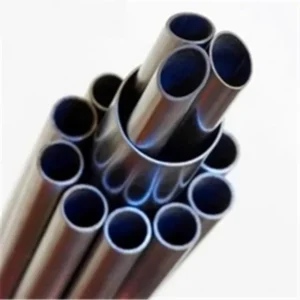
Nitinol wire was cold-drawn and straightened with inline diameter measurement, then chemically descaled and electropolished to a documented surface condition. Each outgoing batch included a DSC report confirming Af within the agreed range, plus dimensional and surface-inspection records. Ti-6Al-4V ELI was supplied annealed to ASTM F136 with compliant chemistry for machined implant parts. Pt-10%Ir tubing had uniform walls for reliable marker-band crimping and clear X-ray visibility.
| Material | Representative Grades | Key Properties | Available Forms |
|---|---|---|---|
| Nitinol (NiTi) | SE508 | Superelasticity, DSC-verified Af | Wire 0.05-2.0 mm, strip |
| Ti-6Al-4V ELI | GR5 (F136) | Biocompatibility and fatigue strength | Bar, wire and strip |
| Platinum-Iridium | Pt-10%Ir | Radiopacity and corrosion resistance | Tube and wire |
View Nitinol Alloys → | View Titanium Alloys → | View Platinum-Iridium Tubes →

SE508 wire and bar

GR5 / F136 implant grade

Pt-10%Ir electrodes
Technical Specifications
Key technical parameters agreed before production. Contact us for grade-specific datasheets and tolerance-verification reports.
| Parameter | Agreed Specification | Verification Method |
|---|---|---|
| Guidewire diameter | 0.35 mm ± 0.005 mm | Laser gauging + micrometer, 100% inline |
| Transformation temperature | Batch Af within a ±5°C range | DSC testing, batch report |
| Surface condition | Oxide-free, electropolished, Ra ≤ 0.4 μm | Profilometer + visual inspection |
| Straightness | ≤ 3 mm/m | Straightness measuring instrument |
| Traceability | Heat number + processing records for every batch | Quality inspection certificate |
Each supplied batch includes a quality inspection certificate with chemical analysis, meeting the applicable standard for each grade.
| Material | Applicable Standards |
|---|---|
| Nitinol (NiTi) | ASTM F2063 (wrought medical Nitinol) |
| Ti-6Al-4V ELI | ASTM F136, ISO 5832-3 |
| Platinum-Iridium | ASTM B684 |
| Quality System | Quality inspection certificate including chemical analysis |
Delivery and Quality Support
- Fast delivery: Sample and production lead times follow the project schedule; standard grades and sizes can be dispatched promptly from stock.
- Quality traceability: Every batch includes material certificates and inspection reports, with full heat and batch traceability.
- Technical support: Responsive support covers pre-sale material selection, drawing review and post-sale processing advice.
- Ongoing service: Regular follow-up after delivery tracks performance and addresses feedback promptly.
Customer Feedback
- First-time qualification: sample and production batches both passed customer incoming inspection on the first attempt
- Dimensional stability: ±0.005 mm diameter maintained in volume production, eliminating customer rework
- Consistent device behavior: DSC-verified Af eliminated batch stiffness differences
- Auditable quality: complete batch chemistry, dimensional, surface and DSC documentation
- Fast sampling: qualification samples in 2 weeks, production in 3-4 weeks
- One supplier, three materials: Nitinol, titanium and platinum-iridium coordinated under one quality system
Our Capabilities
Jiangsu DZX Technology Co., Ltd. (Changzhou DLX Alloy) was founded in 2016. Its core team has worked in the field since 2002, with 24 years of precision-alloy R&D and production experience, operating a self-owned 12,000-square-meter modern factory with an ISO9001 system covering three inspection stages. Annual alloy output exceeds 1,200 tonnes, serving 1500+ business customers worldwide. The company operates integrated melting, drawing, annealing and precision-machining workshops, supporting volume customization of strip, wire, tube and bar. Every batch includes a chemical analysis report (MTC) for full delivery-quality traceability.
Related Products
Medical Applications
Implants, stents, electrodes, surgical instruments and MRI systems
Aerospace Applications
Engine hot sections, airframe structures, satellite mechanisms and rocket hardware
New Energy Applications
Fuel-cell bipolar plates, PEM electrolyzers and battery materials
Energy Industry Applications
Boiler superheaters, nuclear steam generators and steam turbines