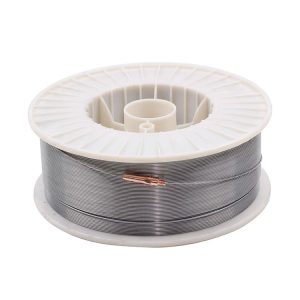
Nickel Welding Consumables Selection Guide: How to Choose the Right Filler Metal for Every Joint
Nickel welding consumables cost an order of magnitude more than stainless steel fillers, yet the most common failure mode is not the weld technique — it’s the wrong grade combined with excessive dilution. When a nickel-based filler is deposited into a carbon steel groove, the base metal melts into the weld pool proportionally. As iron content rises, both crack resistance and corrosion resistance drop together. Selecting the right consumable starts with two questions: what is the base metal, and is the joint responsible for corrosion resistance or strength?
This guide covers the root-pass dilution problem, the five main families of nickel welding consumables, base metal matching, and practical acceptance criteria for demanding applications.
Why Do Nickel Welds Crack? It’s Usually Dilution
Many fabricators use the same filler for both root and cap passes to save time and inventory — but this leaves risk at the root. The root pass typically has the highest base metal dilution of any pass in the joint. In manual welding with high current and wide weaving, dilution rates can reach 20–30%. Iron, carbon, and manganese from the base metal enter the weld pool, and the weld gradually shifts from “nickel-based” to “nickel-iron-based”: thermal expansion coefficient rises, pitting resistance drops, and the solidification range widens.
Molybdenum-containing Ni-Cr-Mo consumables are especially sensitive to this effect. Industry practice treats weld iron content as an acceptance criterion for critical joints, typically held to single-digit percentages. When it exceeds that limit, the solution is either a higher-alloy filler or a transition layer buttered onto the carbon steel side before welding.
Crack location can often confirm the diagnosis. Intergranular cracking near the fusion line is usually associated with low-melting-point eutectics formed after dilution. Solidification cracking in the weld center is more often related to high sulfur or silicon content and an overly wide, shallow bead shape. These two defect types require completely different corrective actions — the first involves changing the filler or heat input, the second involves adjusting parameters and travel technique.
Five Main Families of Nickel Welding Consumables
The most commonly used nickel welding consumables fall into five families based on their strengthening mechanism and composition. They differ not in “quality” but in which base metals they match and which corrosion media they resist.
Base Metal Matching: A Quick Reference
The right consumable depends on what you’re joining. Here’s a practical matching guide:
- Welding 600/800 series alloys or dissimilar steel joints: ERNiCr-3 or ENiCrFe-3. These Ni-Cr-Fe fillers provide good thermal stability and are widely used for transition joints between carbon steel and stainless steel.[reference:4]
- Welding 625 alloy, 9% Ni steel, or chloride service: ERNiCrMo-3 or ENiCrMo-3. The molybdenum content provides resistance to pitting and crevice corrosion in chloride-containing environments. These are also the standard choice for LNG tank construction involving 9% Ni steel.[reference:5]
- Welding Monel 400/500 or seawater piping: ERNiCu-7 or ENiCu-7. The nickel-copper composition matches Monel base metals and provides excellent seawater resistance.
- Welding 718-type high-strength alloys: ERNiFeCr-2. The precipitation-hardening elements (Nb, Ti, Al) match the base metal’s strengthening mechanism.
- Welding pure nickel 200/201: ERNi-1 or ENi-1. The titanium addition provides deoxidation, and the high nickel content matches the base metal chemistry.
Welding Parameters & Practical Tips
Nickel alloys have lower thermal conductivity than steel, so high heat input during welding creates coarse grain structures. The following practices help avoid common defects:
- Avoid excessive current: Nickel and nickel alloys are prone to hot cracking. Use lower current than you would for steel of the same thickness.[reference:6]
- Keep interpass temperature below 150°C: No preheat or postheat is typically required for nickel alloy welding.[reference:7]
- Use DC+ for covered electrodes: Low-hydrogen type nickel-based covered electrodes are designed for DC+ only.[reference:8]
- Maintain a narrow bead: Wide weaving increases dilution and the risk of solidification cracking.
- Control sulfur and silicon: These elements promote centerline solidification cracking. Use low-sulfur consumables and proper shielding gas.
Common Mistakes to Avoid
- Using the same filler for root and cap passes on critical joints: The root pass has the highest dilution and needs a more alloy-rich filler or separate control.
- Ignoring iron content in the weld: For Ni-Cr-Mo consumables, iron content above single-digit percentages degrades both corrosion resistance and crack resistance.
- Testing composition only at the cap: The cap layer reads “clean” while the root may be heavily diluted. Sample at the root pass for accurate results.
- Using ERNiCr-3 where ERNiCrMo-3 is required: If the service environment contains chlorides, the molybdenum content of ERNiCrMo-3 is essential — ERNiCr-3 will not provide adequate pitting resistance.
- Excessive heat input: Nickel alloys’ low thermal conductivity means high heat input produces coarse grains and reduces mechanical properties.
Summary: A Step-by-Step Selection Framework
- Identify the base metal — pure nickel, nickel-chromium-iron, nickel-copper, or high-strength nickel-iron-chromium.
- Determine the joint’s primary requirement — is it corrosion resistance or strength?
- Select the consumable family — use the matching table to narrow to the correct grade.
- Plan for dilution control — specify different fillers for root vs. fill/cap passes on critical joints.
- Set acceptance criteria — define iron content limits and sampling locations for composition checks.
- Verify weld parameters — low current, narrow beads, and interpass temperature below 150°C.
By following this systematic approach, welding engineers and QA/QC personnel can confidently select the right nickel welding consumables for their specific application, ensuring sound joints and reliable long-term performance.