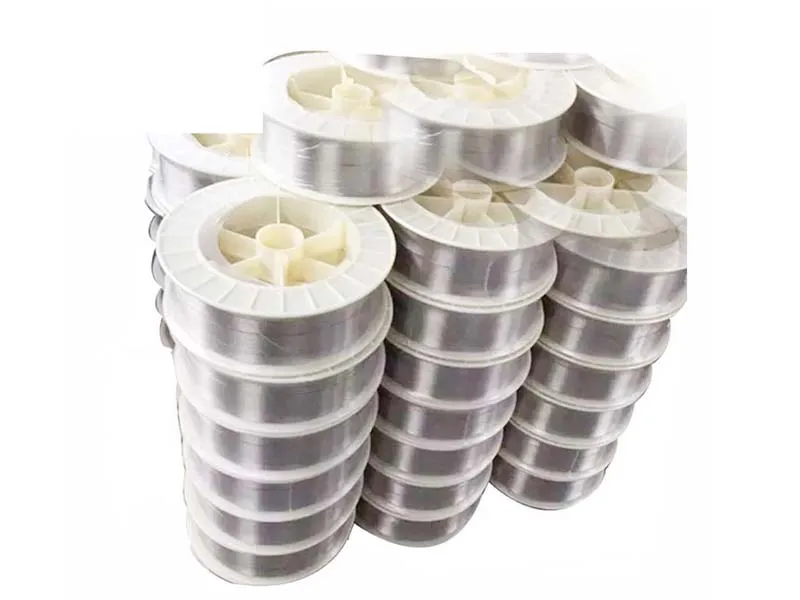
Thermal spray wire

Thermal spraying (Газотермическое напыление) is a process that uses a heat source to heat the covering material to a molten state, atomize it into fine particles under the action of high-speed airflow, and spray it onto the surface of the workpiece at high speed to form a solid coating. This process can impart a variety of physical and chemical properties to parts, including extremely high hardness, wear resistance, corrosion resistance, high temperature resistance and oxidation resistance, electrical insulation or conductive properties, as well as microwave protection and sealing properties.

Cr20Ni80 – Thermal Spray Wire

Thermal spraying (Газотермическое напыление) is a process that uses a heat source to heat the covering material to a molten state, atomize it into fine particles under the action of high-speed airflow, and spray it onto the surface of the workpiece at high speed to form a solid coating. This process can impart a variety of physical and chemical properties to parts, including extremely high hardness, wear resistance, corrosion resistance, high temperature resistance and oxidation resistance, electrical insulation or conductive properties, as well as microwave protection and sealing properties.

Thermal spraying is a process where coating materials are heated and melted, then atomized into fine particles by high-speed airflow. These particles are then sprayed onto the surface of the workpiece at high velocity, forming a strong coating layer. This process imparts various physical and chemical properties to the workpiece, including enhanced hardness, wear resistance, corrosion resistance, heat resistance, oxidation resistance, insulation, electrical conductivity, sealing, sterilization, and microwave radiation protection.

Available grades: Pure Zinc, Inconel 625, Ni95Al5, Monel 400, Cr20Ni80, Monel K500, Hastelloy C-276, 45CT, Ni80Al20

Chemical Composition
Nickel (Ni) 95%
Aluminum (Al) 5%
Physical & Mechanical Properties
Melting Point 1400-1450°C
Density 8.9 g/cm³
Bond Strength ≥ 55 MPa (Flame spray), ≥ 70 MPa (Electric arc spray)
Size 1.2/1.6/2.0mm
Weight of Axle 15kg
Spraying Parameters (Electric Arc Spray)
Parameter Recommended Value
Spray Voltage 30-40V
Spray Current 100-300A
Air Pressure 0.4-0.6MPa
Spray Distance 100-150mm
Preheat Temperature 80-150°C
Coating Thickness 0.1-1.5mm
Applications
  • Corrosion protection: Zinc and aluminum coatings for bridges, ships, and pipelines
  • Wear resistance: Molybdenum coatings for automotive parts such as pistons and gears
  • Thermal barriers: Aluminum-based or nickel-based coatings for turbines and exhaust systems
  • Repair & restoration: Steel and alloy coatings for repairing worn or damaged industrial parts
  • Electrical conductivity: Copper and aluminum coatings for electronic and electrical contacts
  • Versatility: Wide range of materials and substrates
  • Durability: Enhances surface hardness, corrosion resistance, and heat resistance
  • Cost efficiency: Extends the lifespan of expensive components
  • Low heat input: Minimizes deformation of the base material

Frequently Asked Questions (FAQ)

What kind of process is thermal spraying, and what properties can it bring to the surface of the workpiece?

Thermal spraying uses a heat source to heat the wire to a molten state, atomizes it into fine particles under the action of high-speed airflow, and sprays it onto the surface of the workpiece at high speed to form a solid coating. It can give the surface high hardness, wear resistance, corrosion resistance, high temperature resistance and oxidation resistance, electrical insulation or conductivity, microwave protection, sealing and other properties, and has little thermal impact on the base material and less deformation.

Thermal spraying uses a heat source to heat the wire to a molten state, atomizes it into fine particles under the action of high-speed airflow, and sprays it onto the surface of the workpiece at high speed to form a solid coating. It can give the surface high hardness, wear resistance, corrosion resistance, high temperature resistance and oxidation resistance, electrical insulation or conductivity, microwave protection, sealing and other properties, and has little thermal impact on the base material and less deformation.

Thermal spraying uses a heat source to heat the wire to a molten state, atomizes it into fine particles under the action of high-speed airflow, and sprays it onto the surface of the workpiece at high speed to form a solid coating. It can give the surface high hardness, wear resistance, corrosion resistance, high temperature resistance and oxidation resistance, electrical insulation or conductivity, microwave protection, sealing and other properties, and has little thermal impact on the base material and less deformation.

For arc spraying Ni95Al5, the recommended spraying voltage is 30-40 V, the current is 100-300 A, the air pressure is 0.4-0.6 MPa, and the spraying distance is 100-150 mm; the workpiece preheating temperature is 80-150°C, and the coating thickness is controlled at 0.1-1.5 mm to obtain a firmly bonded nickel-aluminum spray coating.

Zinc and aluminum wire coatings are widely used for anti-corrosion on bridges, ships and long-distance oil pipelines; nickel-aluminum alloy coatings are used for thermal protection of gas turbine blades and exhaust systems; molybdenum coatings are used for wear-resistant parts such as automobile piston rings and gears; various alloy wires can also repair heavy-duty industrial parts that are worn or processed to an extreme degree, enabling remanufacturing and extending life.

Contact our specialist now!
Material advice, custom specifications and project support.
Scroll to Top
Send Your Inquriy Today
Download Technical Documentation
Please fill out the form below to receive product brochures, specifications, and technical details.